 ultimate-guide
How to Choose Coffee for Office: 2026 Guide
Table of Contents
- How to Choose Coffee for Office: Start With Headcount and Daily Cups
- Whole Bean vs Ground Coffee for Office
- Choosing an Office Coffee Maker: Single-Cup vs Batch Brewing
- How to Make Good Coffee at Work: Grind, Ratio, and Freshness
- Building an Office Coffee Station That Works for Everyone
- What Office Coffee Really Costs Per Cup
- Cleaning, Storage, and Maintenance Schedules
- Frequently Asked Questions
Last Updated: October 15, 2026
How to Choose Coffee for Office: Start With Headcount and Daily Cups
Figuring out how to choose coffee for office comes down to one question: how many cups does your team actually drink in a day?
A shared coffee station is only as good as its capacity math. Two people who each drink three cups a day need a very different machine than a twelve-person team that empties a carafe before 9 a.m.
Below, we'll walk through headcount, brewing capacity, bean format, equipment, and cost.
Map Your Team's Daily Coffee Consumption
Count cups, not people. A ten-person team where half drink one cup and half drink three is a fourteen-cup morning, before anyone refills after lunch. Track it for a week with a tally sheet by the brewer. Most offices find their real number is higher than their guess, because visitors and the 3 p.m. top-up never make it into anyone's mental math.
Match Brew Capacity to Team Size
Brew capacity should cover your peak hour, not your daily total. If eight cups get poured between 8 and 9 a.m., a brewer that makes twelve cups at once handles the rush in one batch. Size to the busiest sixty minutes and you'll rarely run dry.
Whole Bean vs Ground Coffee for Office
Whole-bean coffee for office use wins on freshness, while pre-ground wins on convenience, and the right pick depends on how fast your team drinks through a bag. Whole beans stay at their best for weeks after opening; ground coffee starts losing aroma within days.
When a Coffee Grinder Earns Its Counter Space
A grinder earns its place when your team finishes a bag within a couple of weeks and someone will grind daily. If your office goes through coffee slowly, pre-ground is the practical call. Our House Blend comes in whole bean, standard grind, or espresso grind.

Choosing an Office Coffee Maker: Single-Cup vs Batch Brewing
Single-cup brewers suit teams with scattered schedules and strong individual preferences; batch brewers suit teams that drink together and want the lowest cost per cup.
A programmable batch brewer with a keep-warm plate, [like the BLACK+DECKER SplitBrew 12-Cup Elite Digital Coffeemaker, bridges the gap](/products/black-decker-splitbrew-12-cup-elite-digital-coffeemaker): set the timer the night before and the pot is ready when the first person walks in.

| Setup | Best For | Per-Cup Cost | Cleanup |
|---|---|---|---|
| Single-cup brewer | Teams with varied schedules | Higher | Low, empty and rinse |
| Batch drip brewer | Teams drinking together | Lower | Carafe and filter basket |
| Pod machine | Small teams, low volume | Higher | Minimal |
| French press | One or two people | Low | Rinse and dry daily |
How to Make Good Coffee at Work: Grind, Ratio, and Freshness
Good coffee at work comes down to three variables you control every morning: grind size, coffee-to-water ratio, and freshness. Get these right and even a basic drip brewer turns out a cup worth drinking.
- Grind for your brewer. Medium grind for drip, coarse for French press, fine for espresso.
- Measure the ratio. Start with roughly one to two tablespoons of ground coffee per six ounces of water, then adjust to taste.
- Use fresh coffee. Check the roast date, not just the best-by date, and buy in quantities you'll finish.
- Keep water hot but not boiling. Drip brewers handle this for you; French press users should let the kettle rest a moment first.
- Clean between brews. Old grounds and oil residue turn any bean bitter.
Building an Office Coffee Station That Works for Everyone
A workable shared coffee station puts everything within arm's reach of the brewer: mugs, filters, a scoop, stirrers, and a clearly labeled bean or pod supply.
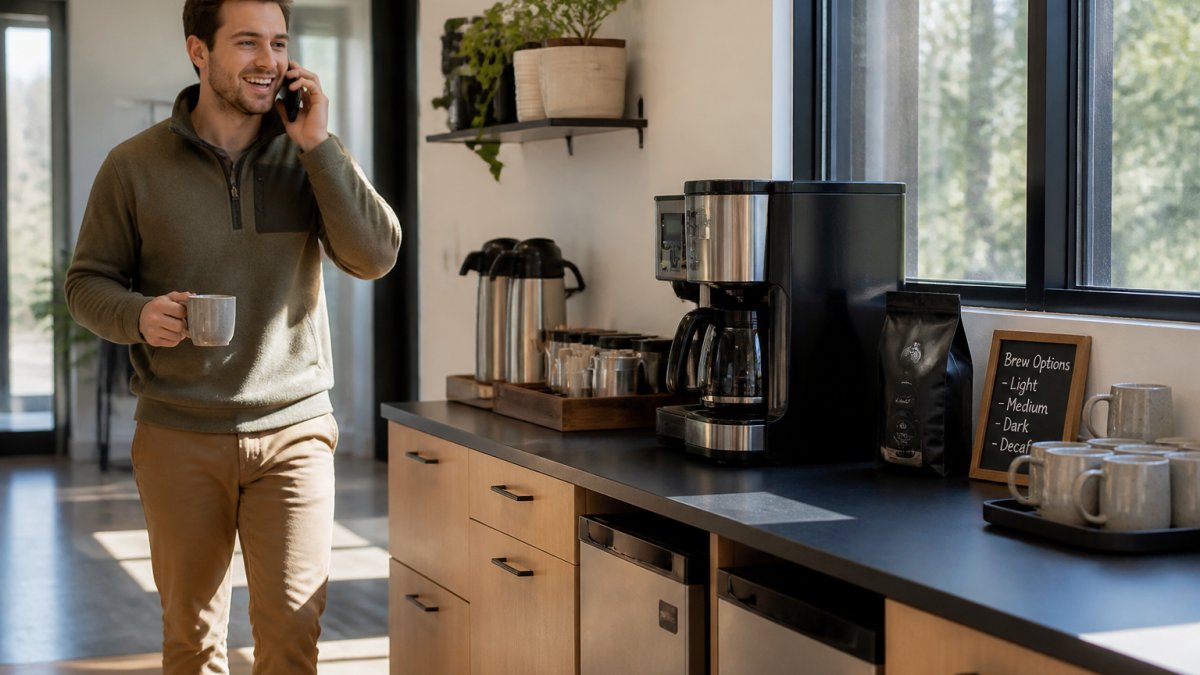
Inclusive options matter here. Keep a decaf option, a non-dairy creamer, and plain hot water for tea alongside the coffee.
What Office Coffee Really Costs Per Cup
Most office coffee guides stop at "batch is cheaper than pods" and leave it there. That's true but not useful, because the per-cup number your finance lead will ask about includes costs that never appear on a coffee bag. The honest way to compare setups is total cost of ownership: equipment, coffee, filters or pods, cleaning supplies, replacement parts, waste, and staff time.
The Cost Components Nobody Itemizes
Every office coffee program has the same six cost buckets:
- Equipment. The brewer, plus a grinder if you go whole bean, plus a scale and scoops. Spread it across the machine's expected service life when comparing setups.
- Coffee. The largest recurring cost. Whole bean and pre-ground are priced per pound; pods are priced per capsule, packaging included.
- Filters and consumables. Paper filters, descaling solution, cleaning tablets, and, for pod machines, nothing beyond the pods.
- Maintenance and parts. Carafes crack, gaskets wear, grinder burrs need replacing. Budget for it.
- Waste. Over-brewed coffee poured down the drain is coffee you paid for and didn't drink.
- Staff time. Someone loads, brews, cleans, and restocks, usually ten to fifteen minutes a day across the team.
Why Batch Brewing Usually Wins on Cost Per Cup
The mechanism is simple: with batch brewing you buy coffee by weight; with pods you buy coffee plus a sealed capsule plus individual packaging, and you pay for all of it.
The trade-off is waste. Batch brewing only wins if the coffee gets drunk: a twelve-cup pot where four cups get poured and eight get dumped costs more per consumed cup than a pod ever will.
When Single-Cup Actually Costs Less
Single-cup setups win on total cost in one scenario: very low, very irregular volume. If two people drink coffee and their schedules rarely overlap, a batch brewer means brewing for one and dumping the rest. The moment a third regular drinker joins, the math flips back toward batch.
A Simple Way to Run Your Own Numbers
You don't need a spreadsheet, just four inputs:
- Daily cups consumed (not brewed, consumed).
- Cost per pound of your chosen coffee, or cost per pod.
- Yield per pound at your ratio (roughly forty to fifty cups per pound at one to two tablespoons per six ounces).
Divide your weekly coffee spend by weekly cups consumed, add a per-cup allowance for filters and cleaning supplies, and you have a defensible number. Run it for both a batch and a pod setup using your real headcount.
Our Best Sellers Sample Pack lets a team try six coffees before committing to a full bag, the most common source of wasted coffee spend in an office.

| Factor | Batch Brewing | Single-Cup |
|---|---|---|
| Coffee cost per cup | Lower, priced by weight | Higher, packaging included |
| Equipment cost | Moderate, one-time | Varies by machine |
| Waste | Higher if over-brewed | Lower per serving |
| Flexibility | One blend at a time | Individual choice |
| Staff time | Brew, clean, restock | Empty and rinse |
| Best fit | Steady daily volume | Low, irregular volume |
Cleaning, Storage, and Maintenance Schedules
Cleaning is the part of an office coffee program everyone forgets and everyone notices. A dirty brewer makes every bean taste stale, no matter how good the coffee is. Coffee leaves behind oils, and those oils oxidize; once residue builds up in a brew basket or carafe, every batch picks up a rancid note.
Why Each Task Matters
- Daily rinse of the carafe and filter basket. Removes the bulk of the oils before they set. Under a minute.
- Daily wipe of the brew basket and hot plate. The hot plate accumulates burnt-on residue fastest and is the most common source of a scorched taste.
- Monthly descaling cycle. Minerals build up on heating elements and tubing, slowing brewing and changing extraction. Vinegar or a commercial descaler both work; follow the manufacturer's instructions.
A Cadence You Can Actually Keep
Daily tasks should take under five minutes total. Weekly tasks, a deeper wipe of the machine exterior, checking the reservoir for film, restocking filters, take ten. Monthly descaling takes twenty to thirty minutes of mostly waiting. Quarterly, inspect the carafe for cracks, check gaskets, and look at grinder burrs.
| Frequency | Task | Time |
|---|---|---|
| Daily | Rinse carafe and filter basket; wipe brew basket and hot plate; wash mugs and spoons | Under 5 min |
| Weekly | Deep-wipe machine exterior; check water reservoir; restock filters and supplies | About 10 min |
| Monthly | Descaling cycle; inspect carafe and gaskets | 20-30 min |
| Quarterly | Check grinder burrs; review roast-date rotation; audit supply levels | Varies |
Assign an Owner
Shared stations with no owner degrade within a month. The fix isn't a chore wheel nobody reads, it's naming one person as station lead with a rotating backup. The lead restocks, runs the descaling cycle, and flags parts that need replacing; everyone else handles their own daily rinse and mug.
Storage That Protects What You Paid For
Buy in quantities your team will finish. A one-pound bag of whole bean stays at its best for a few weeks after opening; pre-ground fades faster. If your office goes through coffee slowly, buy smaller bags more often rather than a bulk order that sits for months. Keep beans airtight and away from the brewer's heat.
Keeping the Station Hygienic
A few habits prevent most problems. Empty and rinse the filter basket right after brewing rather than letting grounds sit. Don't leave standing water in the reservoir between days. Wipe the counter under the brewer weekly. If the machine develops a persistent off taste after a full descaling, the issue is usually the carafe or brew basket, not the coffee.
Frequently Asked Questions
How do you choose coffee for an office?
Start with headcount and daily coffee consumption, then pick a brew method that matches that volume. A team of 10 to 15 people drinking two cups each needs roughly 20 to 30 cups per day, which suits a 12-cup batch brewer run twice. From there, choose whole-bean or pre-ground coffee, decide on roast, and set a cleaning schedule. Let the equipment follow the numbers, not the other way around.
Should an office choose whole-bean coffee, ground coffee, pods, or instant coffee?
Whole-bean coffee gives the best taste because it stays fresh longer and you grind right before brewing, but it requires a grinder and a few seconds of effort. Pre-ground coffee is simpler and still brews well in a standard drip maker if you use it within a couple of weeks. Pods and instant coffee win on convenience and cleanup but cost more per cup and limit your coffee variety.
What is the best office coffee maker for workplace use?
For most offices, a programmable batch brewer is the workhorse. The BLACK+DECKER SplitBrew 12-Cup Elite Digital Coffeemaker ($86.99) brews hot or iced coffee from the same carafe, has a 4-hour keep-warm plate, and a Sneak-a-Cup pause so someone can pour before the cycle ends. Smaller teams or offices with mixed preferences may prefer single-cup brewing alongside it.
How much coffee should an office keep on hand?
A rough rule is 1 to 2 tablespoons of ground coffee per 6-ounce cup, so a 12-cup batch uses about 3/4 to 1 cup of grounds. For a 15-person office at two cups each, that is roughly 30 cups, or about 2 to 2.5 cups of grounds per day. A 12-ounce bag of whole-bean coffee makes about 16 to 20 cups, so plan on one to two bags per week.
What roast is best for a shared office coffee station?
A medium roast is the safest default for a shared station because it balances body and brightness without the heaviness of a dark roast or the acidity some people dislike in light roasts. The House Blend ($26.99) is a medium roast with nutty, sweet chocolate, and mild citrus notes that tastes consistent every brew, which matters when different people are making the coffee.
How can an office make better-tasting coffee?
Three changes fix most office coffee complaints: grind fresh if you use whole bean, measure instead of eyeballing (about 1 to 2 tablespoons per 6-ounce cup), and clean the brewer on a schedule. Stale grounds and a dirty carafe are the usual culprits. If your team wants variety, a sample pack lets people find a favorite before you commit to a full bag.