 blog
Teddy Outdoors vs MiiR: Coffee Mug Comparison
Table of Contents
- Teddy Outdoors vs MiiR: What Each Brand Brings to Outdoor Coffee
- The MiiR Coffee Mug: Design, Insulation, and Everyday Use
- Small Insulated Mugs: Capacity, Weight, and Cup-Holder Fit
- Outdoor Pour-Over Coffee Kit: What to Pack and Why
- How to Choose a Coffee Mug for Camping
- Lids, Leak Resistance, and Cleaning: Side-by-Side Comparison
- Verdict: Which Brand Fits Your Camping Coffee Routine?
- Frequently Asked Questions
Last Updated: October 17, 2026
Teddy Outdoors vs MiiR: What Each Brand Brings to Outdoor Coffee
Choosing between Teddy Outdoors and MiiR comes down to what you actually carry into the field: a rugged tumbler built for abuse, or a refined mug built for ritual.
Both brands sit in the same conversation for good reason. Each sells stainless steel drinkware with vacuum insulation, and each has a following among people who drink coffee far from a kitchen. The difference shows up in the details: lid design, finish, weight, and how the mug feels on day fifty of ownership.
We'll cover what each brand prioritizes, how capacity and cup-holder fit play out in real vehicles and packs, what belongs in an outdoor pour-over coffee kit, and a side-by-side look at lids and cleaning. Keep reading for the selection criteria that matter more than brand loyalty.
The MiiR Coffee Mug: Design, Insulation, and Everyday Use
A MiiR coffee mug is best understood as a design-forward insulated vessel. The brand built its reputation on clean silhouettes, powder-coated finishes, and a press-fit lid system, and that identity carries into how the drinkware performs day to day.
Insulation is the headline. Double-wall vacuum construction keeps heat retention steady through a commute or a slow morning at camp, and the same build holds cold retention for iced coffee in summer.
Where MiiR earns its fans is consistency. Finishes resist chipping, the lid seals well for a press-fit design, and the profile fits most cup holders without wobbling. The trade-off is that press-fit lids are not built for a tumble in a pack.
Small Insulated Mugs: Capacity, Weight, and Cup-Holder Fit
Small insulated mugs solve a specific problem: you want a hot drink in hand without hauling a thermos. Most compact models land in the 8 to 12 ounce range, which is enough for a single pour-over serving and light enough to clip to a daypack without noticing the weight.
Capacity and weight trade off directly. An 8 ounce mug saves ounces in the pack but forces a refill mid-morning. A 12 ounce model carries more coffee but takes up more room in a cup holder and a side pocket. For commuting, 12 ounces is the practical sweet spot. For backpacking, 8 ounces wins.
Matching models by capacity
Rather than compare a brand's smallest mug to its largest, line up equivalent sizes:
- 8-10 oz: best for backpacking and single-serve pour-over. A press-fit lid is fine here because the mug rides upright in a side pocket.
- 12 oz: best all-around for commuting and car camping. This is the size where a screw-on lid earns its keep, since a 12 ounce mug is the one most likely to get packed sideways.
- 16 oz and up: best for desk use and long drives, not for packing. A full 16 ounce mug is heavy enough that you will notice it on a long hike.
Cup-holder fit
Cup-holder fit deserves more attention than it gets. A tapered base fits console holders in most vehicles; a straight-sided tumbler often does not. Measure the base diameter of the mug and the opening of your console holder before you buy, especially if the mug will live in a truck cupholder on the way to a trailhead. A tapered base in the 2.5 to 2.8 inch range fits most console holders; a straight-sided tumbler wider than about 3 inches usually will not.
Weight in the pack
Weigh the empty mug on a kitchen scale before a trip. A compact 8 ounce stainless mug typically lands in the 6 to 8 ounce range empty, while a 12 ounce model runs closer to 10 to 12 ounces. That difference is trivial on a commute and meaningful on a multi-day hike where every ounce counts. Pick the smallest capacity that covers your routine, then confirm the lid style matches how the mug will travel.
Outdoor Pour-Over Coffee Kit: What to Pack and Why
An outdoor pour-over coffee kit is a compact set of brewing gear designed to produce a single clean cup at a campsite or trailhead. The kit matters more than the mug because a great vessel cannot rescue a bad brew.
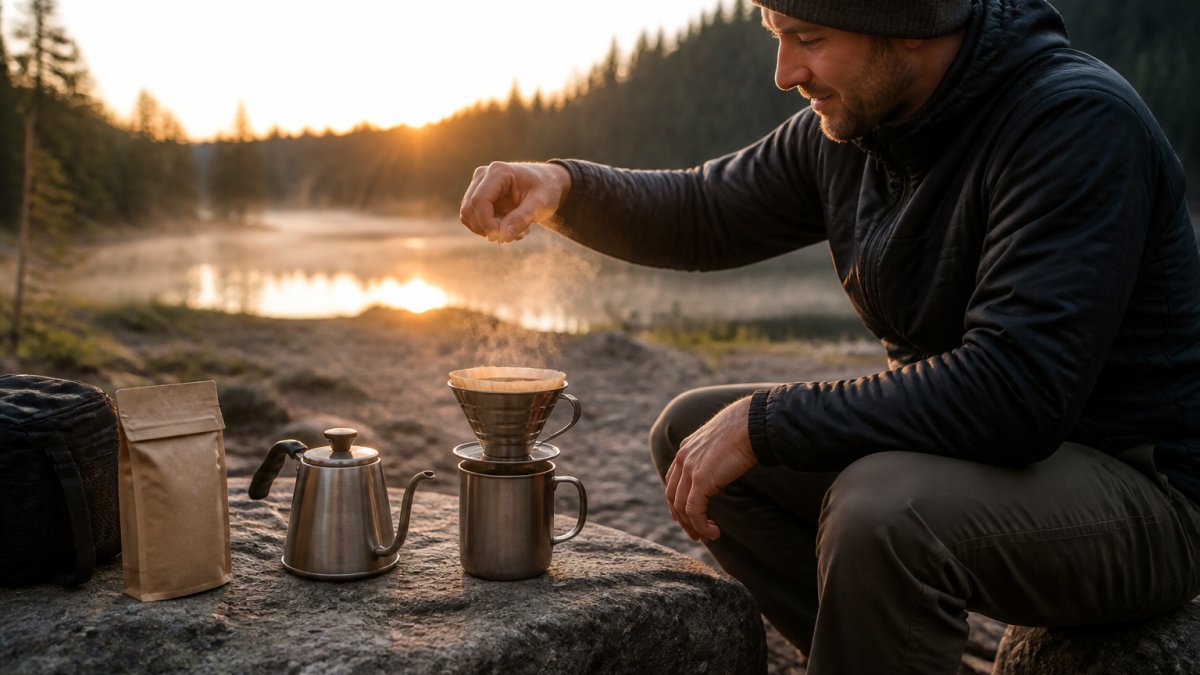
Here is what we would pack, in order of importance:
- A dripper. A collapsible silicone or lightweight plastic cone packs flat and weighs almost nothing.
- A paper filter supply. Pre-folded filters in a zip bag stay dry and stack small.
- A small kettle or a pot with a spout. Control over the pour matters more than volume.
- Pre-measured coffee. Dose beans at home in small bags so you are not guessing in the wind.
- An insulated mug with a lid. This is where heat retention earns its keep on a cold morning.
- A small scale or a marked scoop. Consistency beats precision when you are outdoors.
The mug is the last item on the list but the one you touch most. A lid that seals and a body that holds heat turn a good brew into a good twenty minutes.
How to Choose a Coffee Mug for Camping
Learning how to choose a coffee mug for camping means weighing five factors in a fixed order: lid security, insulation, weight, capacity, and cleaning. Get the order right and the decision takes about two minutes.
Start with the lid. A camping mug will get knocked over, packed sideways, and set on uneven ground. A screw-on lid with a silicone gasket is the only design we trust inside a pack. Flip lids and sliding lids work for commuting but leak under pressure.
Next, insulation. Vacuum insulation keeps temperature retention predictable, and double-wall construction prevents condensation on the outside, which matters when the mug sits on your sleeping bag. Then weight: ounces add up fast on a long hike, so pick the smallest capacity that covers your routine. Finally, cleaning.
Lids, Leak Resistance, and Cleaning: Side-by-Side Comparison
Leak resistance separates a travel mug from a tumbler, and the two brands take different routes to the same goal. The table below summarizes how the design choices play out in practice, followed by the like-for-like testing method we use and the long-term ownership details most roundups skip.
| Feature | Teddy Outdoors approach | MiiR approach |
|---|---|---|
| Lid type | Screw-on with silicone gasket | Press-fit on most mugs; screw-on on select tumblers |
| Leak resistance | High, pack-safe when torqued down | Moderate, upright use |
| One-handed operation | Flip or slide option on some lids | Press-fit, two hands |
| Cleaning | Wide mouth, removable gasket | Wide mouth, hand-wash friendly |
| Gasket replacement | Spare gaskets sold separately | Spare gaskets sold separately |
| Warranty | Limited lifetime on the body | Limited lifetime on the body |
| Best for | Camping, fishing, pack carry | Commuting, desk, car |
How we test like-for-like
Comparing a 12 ounce screw-on tumbler against an 8 ounce press-fit mug tells you nothing. We match capacity and lid style first, then run the same three checks on both:
- Inverted leak test. Fill each mug with water, seal the lid, invert it, and shake for 30 seconds over a towel. A screw-on lid with an intact gasket should stay dry; a press-fit lid will usually weep at the seam once pressure builds.
- Temperature retention. Pre-heat each mug with hot tap water for two minutes, pour in 200°F water, cap it, and take a reading at 1 hour and 4 hours with the same instant-read thermometer. Vacuum insulation on both brands holds well past the first hour; the gap widens after hour three, and lid design matters as much as the vacuum layer because heat escapes through the opening.
- Cleanability. Brew coffee, let it sit 30 minutes, rinse, and inspect the gasket channel. A removable gasket rinses clean in a stream or a camp sink; a press-fit lid traps residue in the seam and needs a brush.
Long-term wear and warranty coverage
Durability and build quality land close to even. Both brands use stainless steel bodies with powder-coated finishes that resist scratching, and both hold up to normal drops. Long-term wear shows up first in the gasket, not the body. A spare gasket is the cheapest repair you can keep on hand, and it extends the life of either mug by years.
Cleaning is where the screw-on lid wins at camp. A removable gasket rinses clean in a stream or a camp sink, while a press-fit lid traps coffee residue in the seam and needs a brush. Neither mug is truly dishwasher-safe in the way a ceramic mug is, so plan on hand-washing and a bottle brush.
Verdict: Which Brand Fits Your Camping Coffee Routine?
Here is our honest read. If your coffee happens on a tailgate, a boat, or a tent pad, choose the mug with a screw-on lid and a gasket you can replace. If your coffee happens on a desk or in a car, a press-fit design like the MiiR coffee mug is a pleasure to use and looks the part.
For campers who want the whole ritual to travel well, our coffee collection at Ridgeline Trail & Coffee pairs insulated drinkware with single-serve specialty blends. That combination is what we would pack for a cold morning on the water.
The right mug is the one you will actually carry. Pick the lid first, then the capacity, then the finish, and you will get years out of it.
Frequently Asked Questions
What is the difference between Teddy Outdoors and MiiR?
Teddy Outdoors focuses on rugged outdoor gear and coffee products built for camping and trail use, while MiiR is known for stainless steel drinkware with a focus on design and sustainability. In practice, the difference shows up in lid style, insulation performance, and how each mug handles rough handling. Teddy Outdoors leans toward practical outdoor functionality, and MiiR leans toward everyday carry and brand-driven aesthetics. Your choice depends on whether you prioritize camp durability or daily commuting convenience.
Is MiiR drinkware suitable for outdoor coffee?
Yes, MiiR coffee mugs work for outdoor coffee when paired with a pour-over kit or pre-ground coffee. Their double-wall vacuum insulation holds temperature well, and the stainless steel interior resists taste transfer. For camping, check that the lid seals tightly and the mug fits your cup holder or pack pocket. MiiR mugs are not designed as rugged camp gear, so handle them with care around rocks and hard surfaces. They suit car camping and basecamp brewing better than rough backcountry use.
What should I look for in an insulated coffee mug?
Look for double-wall vacuum insulation, a leakproof lid with a silicone gasket, and a capacity between 12 and 16 ounces for camping. Check that the mug fits your vehicle cup holder and your pack's side pocket. Stainless steel construction resists dents and taste transfer better than plastic. A wide mouth makes cleaning easier, and dishwasher-safe models save time at camp. Weight matters too: a lighter mug is easier to carry on long hikes, but it may sacrifice insulation performance.
How do I choose a mug for pour-over coffee outdoors?
Choose a mug with a wide enough mouth to fit your pour-over dripper, usually 3 inches or more in diameter. A 12 to 16 ounce capacity gives you room for a full pour without overflow. Insulation keeps the coffee hot while you brew, and a lid helps retain heat between pours. Look for a mug that is stable on uneven ground and easy to clean without a dishwasher. Pair it with a compact pour-over kit that nests inside the mug for packing efficiency.
The hardest part of camp coffee is not the brew, it is the gear that has to survive the trip. If you want a mug and a coffee that are built for the same mornings you are, Ridgeline Trail & Coffee stocks insulated drinkware alongside single-serve specialty blends and outdoor-ready gear. Browse the coffee collection and build a kit that works at the trailhead, not just in the kitchen. Search our catalog to get started.