
 how-to
How to Choose Ski Goggles for Low Light: 2026 VLT Guide
Table of Contents
- Why Low Light Changes Everything on the Mountain
- Understanding VLT: The Number That Makes Low Light Ski Goggles Work
- Ski Goggle VLT Chart: Matching Lens Tint to Conditions
- Flat Light vs. Night Skiing: Two Different Problems
- Interchangeable Lenses, Fit, and Prescription Inserts
- Anti-Fog Goggle Maintenance for Damp, Overcast Days
- How to Choose Ski Goggles for Low Light: Step-by-Step
- Conclusion
- Frequently Asked Questions
Last Updated: September 14, 2026
Why Low Light Changes Everything on the Mountain
Flat light erases the shadows that tell your brain where the ground actually is. On a bluebird day, a mogul casts a shadow and your depth perception does the rest. Under overcast skies, that contrast disappears, and the snow surface turns into a single gray sheet.
Visible Light Transmission (VLT) is the percentage of light that passes through a goggle lens to your eye. A high-VLT lens lets more light in; a low-VLT lens blocks it. That single number decides whether you see texture in flat light or stare into a void.
The stakes are real. Low contrast contributes to vertigo on the slope, a disorienting sense that the horizon has tilted or vanished. Skiers describe it as the ground and sky merging into one gray field. The fix isn't a better attitude. It's the right lens.
Understanding VLT: The Number That Makes Low Light Ski Goggles Work
VLT percentage is the core specification on any goggle box, and it's the one most skiers ignore. Here's how the range breaks down:
- 80-90% VLT: Clear or near-clear lenses. Built for night skiing and deep storm days.
- 50-70% VLT: Yellow, amber, and rose tints. The workhorse range for overcast and flat light.
- 20-40% VLT: All-around lenses for mixed sun and cloud.
- 5-15% VLT: Dark tints for bright, high-altitude sun.
What VLT Percentage Means in Practice
A lens rated at 60% VLT lets roughly six of every ten photons reach your eye. That sounds like a lot until you're on a north-facing slope at 2 p.m. in December, where ambient light is already cut by the cloud deck and the terrain's own shading.
Most skiers own one lens and wonder why it fails half the season. The honest answer: one lens can't cover both a sunny groomer and a storm day. Low-light performance is a separate purchase decision, not an afterthought.
Ski Goggle VLT Chart: Matching Lens Tint to Conditions
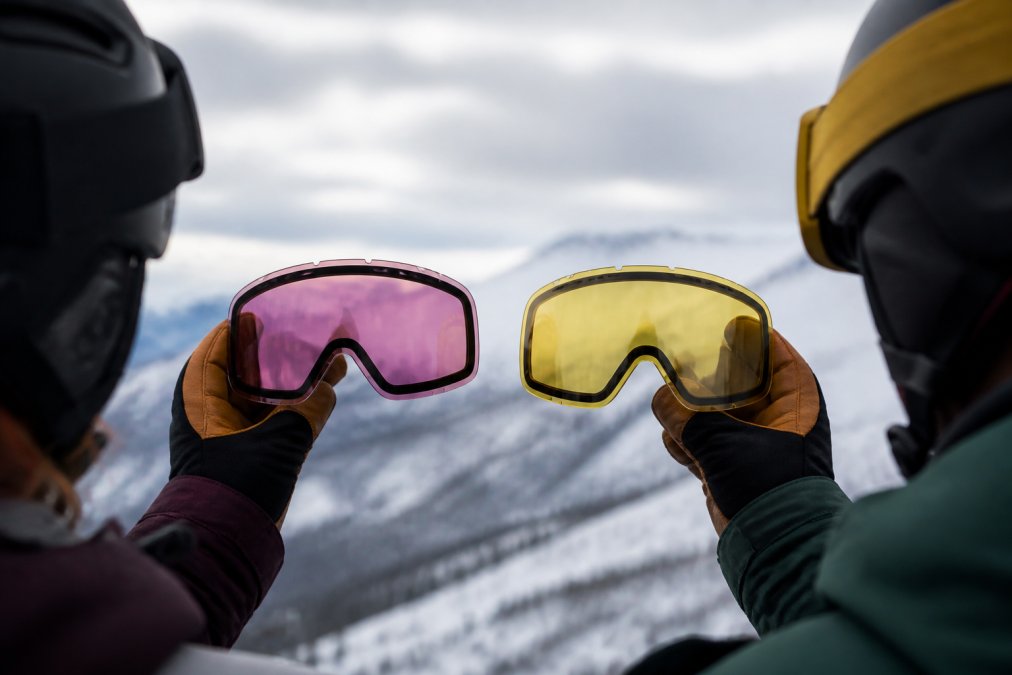
The table below maps tint color to conditions, which is the fastest way to narrow your options before you ever try a pair on. But read the section after it, the table alone will steer you wrong if you don't account for what kind of snow you're skiing on.
| Lens Tint | Typical VLT Range | Best Conditions | Trade-Off |
|---|---|---|---|
| Clear | 80-90% | Night skiing, heavy snow | No glare reduction in sun |
| Yellow | 60-80% | Dense fog, flat light | Washes out color contrast |
| Rose | 40-60% | Overcast, mixed cloud | Weak in bright sun |
| Amber | 50-70% | Storm days, low contrast | Can feel too warm in tone |
| Blue | 15-30% | Bright sun, high altitude | Poor in flat light |
Lens Tint Science for Specific Snow Types
Tint color isn't cosmetic, and "flat light" isn't one condition. Different tints filter different wavelengths, and the snow surface underneath those clouds changes which wavelengths matter. This is the part most goggle guides skip, and it's where the real decisions live.
Flat light over fresh powder. Powder is bright but shadowless under an overcast sky, it reflects a huge amount of diffuse light while offering almost no texture. The problem here is too much brightness with too little contrast. A rose lens in the 50-60% VLT range is the practical pick: it cuts the overall brightness enough to reduce eye strain while boosting the blue-gray contrast that reveals the subtle undulations in the powder. Amber works too, but rose tends to read powder texture more cleanly for most skiers.
Flat light over icy or hard-pack snow. This is a different animal. Ice and hard-pack are darker and more reflective than powder, and under flat light they can look almost identical to the packed groomer next to them. The danger is misreading a patch of ice as soft snow. Here you want a tint that maximizes contrast between the darker, glossier ice and the lighter, matte snow around it. Amber and yellow tints tend to outperform rose in this specific scenario because they push the overall contrast harder, even at the cost of some color fidelity. A 60-70% VLT amber is a common choice for skiers who spend most of their time on hard-pack Eastern or Midwestern terrain.
Flat light over wet or spring snow. Wet snow is darker and heavier, and it absorbs more light than dry powder. You need more VLT here than you would on a powder day, think 65-75%, and a tint that doesn't further darken the already-dull surface. Yellow or a light rose works well; avoid anything with a heavy mirror coating, which cuts too much light.
The takeaway for tint selection. Rose is the generalist for flat light. Amber is the specialist for hard-pack and ice. Yellow is the aggressive-contrast option for fog and dense storm light. If you ski a mix of powder and hard-pack in low light, a rose lens at 55-60% VLT is the safest single choice, but if you know your local mountain is mostly groomed hard-pack, amber will serve you better.
Flat Light vs. Night Skiing: Two Different Problems
Flat light and night skiing get lumped together, but they demand different lenses, and more importantly, they break your vision in different ways. Understanding the mechanism behind each is what turns a lens recommendation into a decision you can actually make on the mountain.
What Flat Light Actually Does to Your Vision
Flat light is an overcast daytime problem. The cloud deck diffuses sunlight into a uniform gray wash, and the snow surface reflects it back with almost no variation. Shadows, the primary cue your brain uses to judge slope angle, drop-offs, and the shape of a mogul field, simply disappear.
The result is a well-documented phenomenon skiers call the "white room" or "flat-light vertigo." With no horizon line and no shadow gradient, your vestibular system (the inner ear, which senses tilt and acceleration) and your visual system start disagreeing. Your inner ear says you're moving; your eyes say nothing is moving because there's no visual reference. The brain resolves the conflict badly, and you get that tilting, floating, disoriented feeling that makes people stop dead in the middle of a run.
This is not a toughness problem. It's a sensory-input problem, and the fix is restoring contrast. A 50-70% VLT rose or amber lens does this by filtering the blue-gray wavelengths that dominate overcast light and amplifying the subtle tonal differences between packed snow, powder, and ice. The texture comes back, the horizon reappears, and your two balance systems stop fighting.
What Night Skiing Actually Does to Your Vision
Night skiing is a low-ambient-light problem, not a contrast problem. The only illumination comes from floodlights, which create harsh pools of light separated by genuinely dark gaps. Your eyes are constantly adapting between the two, and that adaptation takes time, which is why night runs can feel like skiing through a strobe effect.
For night skiing, you want 80% VLT or higher, often a clear lens. Any tint costs you photons you can't afford to lose. The goal is maximum light transmission, not contrast enhancement, because the floodlights already provide the contrast.
The Overlap: Glare Management
Glare reduction matters in both cases but for different reasons. On a bright overcast day, snow glare can still be intense even without direct sun, the cloud deck acts as a giant diffuser, and the snow reflects that diffuse light straight up into your eyes. At night, you're managing the harsh pools of light from the towers, not the sun. A lens with a slight mirror or flash coating can cut that overhead glare without sacrificing too much VLT, which is why some night-specific lenses pair a high VLT with a mild mirror finish.
Interchangeable Lenses, Fit, and Prescription Inserts
Interchangeable lens systems solve the one-lens problem directly. Most modern goggles use a magnetic or clip-in system that lets you swap lenses in under a minute, so you can carry a rose lens for the morning and a dark lens for the afternoon.
Frame ventilation and face foam matter more than most buyers expect. Good ventilation moves air across the inner lens surface and keeps fogging resistance high. Face foam seals against your face without crushing your nose, and it's the difference between a comfortable fit and a headache by noon.
Prescription Insert Compatibility
Prescription inserts are a small frame that clips inside the goggle and holds your corrective lenses. Most major goggle brands offer compatible inserts, but compatibility is model-specific. Check before you buy, because an insert that doesn't fit your frame is useless.
If you wear glasses under goggles, an insert is almost always more comfortable than trying to layer glasses inside the frame. It also reduces fogging because there's less surface area trapping warm, moist air.
Anti-Fog Goggle Maintenance for Damp, Overcast Days
Anti-fog goggle maintenance is what separates a lens that works all season from one that fogs up on every lift ride. Overcast and storm days are the worst case: high humidity, cold air, and a warm face behind the lens.
The rules are simple and most people break them:
- Never wipe the inside of the lens with a glove or cloth. You'll strip the anti-fog coating.
- Let the goggle air-dry at room temperature after each day. Don't leave it in a hot car or a gear bag.
- Shake snow out of the frame vents rather than packing it in.
- Store the goggle in its soft bag, not loose in a pack.
- Replace lenses when the coating visibly wears, not when fogging makes you miserable.
Anti-fog coating is applied at the factory and it wears with handling. Treat the inner lens like a camera sensor, not a windshield.
How to Choose Ski Goggles for Low Light: Step-by-Step
Conclusion
When you're building out your kit, Ridgeline Trail & Coffee carries premium coffee for exactly these days, from the first lift ride to the drive home. Browse the collection and pack a bag of single-serve coffee for the thermos. Search the catalog and gear up before the next storm cycle rolls in.
Frequently Asked Questions
What color lens is best for low-light skiing?
Rose and yellow tints work best in flat light and overcast conditions. Rose boosts contrast on gray snow without darkening the scene, while yellow filters blue light and sharpens definition in fog or snowfall. Amber sits between the two and handles mixed conditions well. Avoid dark gray or mirrored lenses in low light; they cut too much visible light and flatten depth perception. Match your tint to the VLT percentage: higher VLT (above 50%) plus a rose or yellow base color is the standard combination for stormy days.
How does Visible Light Transmission (VLT) affect low-light performance?
VLT measures how much visible light passes through a lens. A 60% VLT lens lets in 60% of available light, which matters when clouds, snow, or late-afternoon shadows reduce what reaches your eyes. For low light, look for 50-80% VLT. Below 40% is built for bright sun and will leave you squinting into gray. Above 80% suits night skiing or dense fog. The ski goggle VLT chart in this guide maps percentages to specific conditions so you can pick a lens before you buy.
Should I choose interchangeable lenses for variable weather?
Yes, if you ski in regions where conditions shift through the day. An interchangeable lens system lets you swap a low-VLT sun lens for a high-VLT storm lens in under a minute, often without removing your helmet. Magnetic and quick-release systems are the easiest to use with gloves on. If you only ski overcast groomers, a single rose or yellow lens in the 50-70% VLT range covers most days and costs less.
How do I prevent fogging in low-light, high-humidity conditions?
Anti-fog goggle maintenance starts with never wiping the inside of the lens; that removes the factory anti-fog coating. Let lenses air-dry, and shake off snow instead of rubbing. Keep frame ventilation clear of snow and scarves, and seal the goggle against your face with a snug but not tight strap. Prescription inserts and balaclavas push moist air upward, so tuck the balaclava under the goggle foam. Replace lenses once the coating breaks down; fogging resistance fades with age.