 how-to
How to Save on Specialty Coffee: 7 Practical Ways
Table of Contents
- Why Specialty Coffee Costs More and Where the Money Goes
- Step 1: Calculate Your Real Cost Per Cup
- Step 2: Buy Larger Bags and Compare Price Per Pound
- Step 3: Use Specialty Coffee Subscriptions and Delivery Discounts
- Step 4: Learn How to Store Coffee Beans Without Losing Freshness
- Step 5: Nail Your Coffee Brewing Ratios to Stop Wasting Beans
- Step 6: Making Coffee at Home vs. Buying Cafe Drinks
- Step 7: Reduce Shipping Costs and Combine Orders
- Frequently Asked Questions
Last Updated: October 12, 2026
Why Specialty Coffee Costs More and Where the Money Goes
Learning how to save on specialty coffee starts with understanding why it costs more in the first place.
The higher price tag traces back to how the beans are grown, picked, and shipped. Specialty lots are often hand-picked, processed in small batches, and roasted in limited runs. Each step costs more than the mass-market route.
Here's where your money actually goes:
- Green coffee from the farm
- Processing and shipping
- Roasting in small batches
- Packaging and freshness sealing
- Retail or delivery markup
The good news: none of that means you have to overpay. Below, we'll show you exactly how to cut your coffee spending without giving up quality.
Step 1: Calculate Your Real Cost Per Cup
The fastest way to save on specialty coffee is to know your true cost per cup. Most people guess. Few actually measure. Once you run the numbers, you'll see where the waste hides.
The Simple Cost-Per-Cup Formula
Cost per cup = (bag price ÷ ounces in bag) × ounces per brew
Here's a real example. A 12 oz bag at $18 works out to $1.50 per ounce. If you brew 0.75 oz of coffee per cup, that's about $1.13 per cup. Compare that to a $5 café latte and the gap is obvious.
Keep two numbers handy:
- Price per ounce of beans
- Ounces you use per brew
That's it. No spreadsheets required.
A Budget Worksheet for Your Coffee Habit
Try this simple worksheet to see your monthly coffee budget:
| Item | Example | Your Number |
|---|---|---|
| Bag price | $18 | ___ |
| Bag size (oz) | 12 | ___ |
| Cost per ounce | $1.50 | ___ |
| Ounces per brew | 0.75 | ___ |
| Cost per cup | $1.13 | ___ |
| Cups per day | 2 | ___ |
| Monthly cost | $67.80 | ___ |
Step 2: Buy Larger Bags and Compare Price Per Pound
Buying larger bags is the single easiest way to lower your price per pound. A two-pound bag almost always costs less per ounce than two one-pound bags. The same holds for a five-pound bag, as long as you can finish it before it fades.
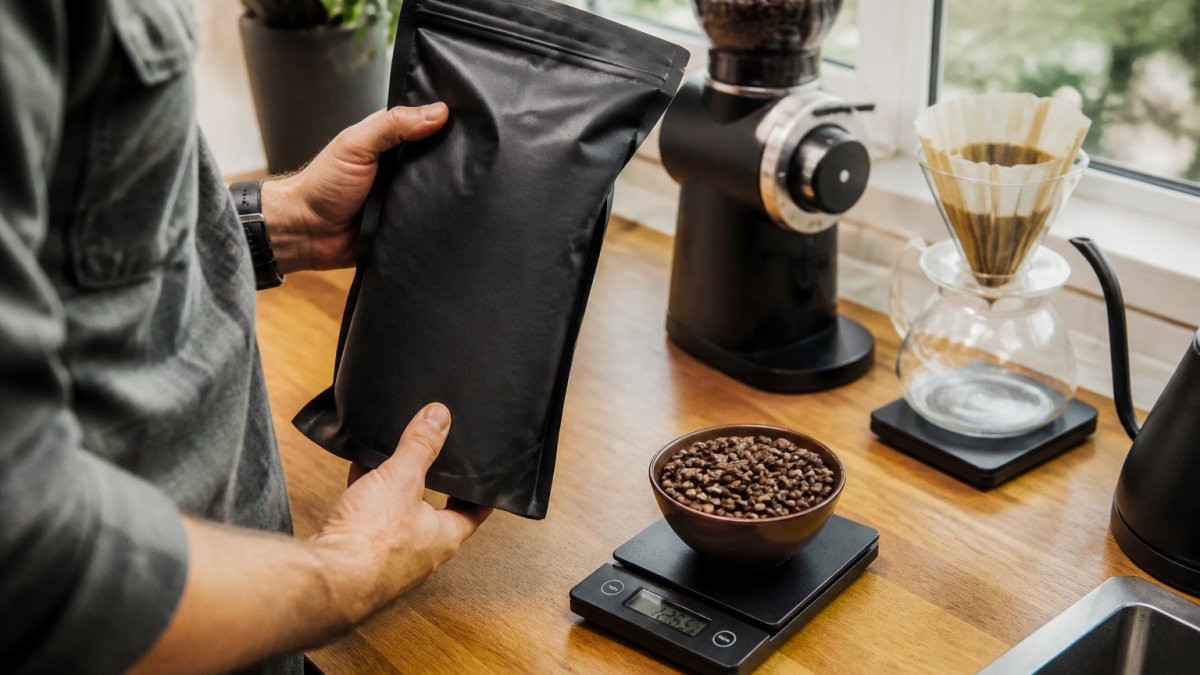
The catch is freshness. Bulk only saves money if you actually drink it. Most roasters print a roast date on the bag, and whole beans hit their peak flavor roughly 4 to 14 days after roasting. After about four to six weeks, the oils that carry origin character start to fade, and the cup turns flat and papery.
Match Bag Size to Your Actual Consumption
Start with your weekly usage. If you brew two cups a day at about 0.75 oz per cup, that's roughly 10.5 oz per week. Here's how bag sizes shake out:
| Bag size | Weeks of coffee at 10.5 oz/week | Verdict |
|---|---|---|
| 12 oz | ~1.1 weeks | Fresh, but you reorder often |
| 2 lb (32 oz) | ~3 weeks | Sweet spot for most daily drinkers |
| 5 lb (80 oz) | ~7.6 weeks | Only if you freeze portions |
A two-pound bag lands inside the freshness window for a two-cup-a-day habit. A five-pound bag does not, unless you split it.
How to Buy in Bulk Without Losing Freshness
This is the part most guides skip. You can absolutely buy five pounds and keep every cup fresh, but only if you portion it the day it arrives:
- Divide into one- to two-week portions. Weigh out what you'll brew in that window and seal each portion separately.
- Freeze the portions you won't touch soon. A sealed bag in the freezer slows staling dramatically. Take out one portion at a time.
- Keep the active portion at room temperature. Store it in an airtight, opaque container away from the stove and window.
- Don't refreeze the same beans repeatedly. Each thaw cycle pulls moisture onto the beans. Portion once, thaw once.
- Let a frozen portion rest before grinding. Give it a few hours to come to room temperature so it grinds evenly.
Done this way, a five-pound bag can cost meaningfully less per ounce than a two-pound bag and still taste fresh for months.
Compare Price Per Pound, Not Bag Price
A $30 two-pound bag beats a $17 one-pound bag every time on unit cost. Do the division before you check out: bag price divided by ounces, then multiplied by 16 for price per pound.
If you're not sure which beans you'll love, start with a sample pack. Our Best Sellers Sample Pack gives you six 2 oz bags so you can find your go-to before committing to a full-size bag.

Step 3: Use Specialty Coffee Subscriptions and Delivery Discounts
Specialty coffee subscriptions are recurring bean deliveries that often come with a lower per-bag price and free or reduced shipping. They work because roasters can plan ahead and pass some savings back to you.
What to look for in a subscription:
- A discount off the one-time price
- Free shipping above a set order size
- The ability to pause or skip a delivery
- A roast date on every bag
The real win is combining orders. One delivery of two bags usually ships cheaper than two separate deliveries. If you drink coffee daily, a subscription locks in a lower rate and removes the guesswork.
Step 4: Learn How to Store Coffee Beans Without Losing Freshness
Knowing how to store coffee beans is what makes bulk buying actually pay off. Buy in bulk, store it wrong, and you've wasted the savings.
The rules are simple:
- Keep beans whole until you brew
- Store in an airtight, opaque container
- Keep away from light, heat, and moisture
- Buy only what you'll finish in a few weeks
Whole beans stay fresh far longer than pre-ground coffee. That's why a grinder pays for itself. Grinding right before you brew protects the oils that carry flavor.
For longer storage, freeze a portion in a sealed bag and take it out as needed. Don't refreeze the same beans over and over.
Step 5: Nail Your Coffee Brewing Ratios to Stop Wasting Beans
Coffee brewing ratios are the amount of coffee to water you use, and getting them right is free money. Too strong, and you burn through beans. Too weak, and you brew twice.
The common starting point is 1 gram of coffee to 15 to 18 grams of water. From there, adjust to taste. A kitchen scale makes this easy and consistent.
- 1:15 for a bolder cup
- 1:16 for a balanced cup
- 1:18 for a lighter cup
Measure once, dial it in, then repeat. You'll use less coffee per cup and get a better result. This is one of the most overlooked ways to save on specialty coffee, because it costs nothing and works with any brewer.
Step 6: Making Coffee at Home vs. Buying Cafe Drinks
Making coffee at home is the biggest single lever on your coffee budget. A homemade cup costs a fraction of a café drink, even with premium beans. The trade-off is equipment, and that's where most guides get vague. Let's put real numbers on it.
Equipment Costs and Payback Period
The payback period is simply how many café drinks you'd have to skip to cover the cost of your setup. Assume a café drink runs about $5 and a home-brewed cup of specialty coffee runs about $1.13 in beans. That's a savings of roughly $3.87 per cup.
| Setup | Typical Equipment Cost | Cost Per Cup (Beans) | Cups to Break Even | Payback at 2 Cups/Day |
|---|---|---|---|---|
| French press | $20-$40 | $1.13 | 6-11 cups | Under a week |
| Pour-over dripper + filters | $25-$50 | $1.13 | 7-13 cups | About a week |
| Drip machine | $40-$120 | $1.10 | 11-32 cups | 1-2 weeks |
| Manual burr grinder | $40-$80 | , | 11-21 cups | About a week |
| Electric burr grinder | $100-$200 | , | 26-52 cups | 2-4 weeks |
| Espresso machine | $300-$800+ | $0.90 | 78-208 cups | 1-3 months |
A few things jump out. A French press or pour-over setup pays for itself in days, not months. The grinder is often the bigger upfront cost, but it's the piece that unlocks whole-bean freshness and lets you buy in bulk.
Low-Cost Brewing Setups That Still Taste Great
You don't need a wall of gear. A capable starter kit is a burr grinder, a scale, and one brewer. Here's how to keep the cost down:
- Buy a manual burr grinder first. It's cheaper than electric and grinds consistently enough for pour-over and French press.
- Skip the espresso machine unless you drink espresso daily. The payback is longest and the learning curve is steepest.
- Use a kitchen scale you already own. Gram-accurate measurement is the cheapest upgrade you can make.
- Start with one brewer. A pour-over dripper or French press covers most styles; add gear only when you know what you like.
When Home Brewing Doesn't Pay Off
Home brewing wins on cost for anyone drinking coffee most days. But if you brew one cup a week, the equipment may never pay back before it collects dust. In that case, buying a smaller amount of great coffee and brewing it well beats buying gear you won't use.
Our Instant Coffee skips the gear entirely. Thirty servings in a resealable pouch, just add hot water. It's real coffee with no equipment to buy.

Step 7: Reduce Shipping Costs and Combine Orders
Shipping can quietly erase your savings. A few habits keep it in check.
- Combine orders into one delivery
- Hit the free-shipping threshold when you can
- Split a large order with a friend
- Choose slower shipping when timing isn't tight
If you buy from a roaster directly, you often cut out a middle layer of markup. Buying direct also means fresher beans with a visible roast date. For a full range of options, browse our coffee collection and build one order instead of several.
Frequently Asked Questions
How can I get a discount on specialty coffee beans?
Buying larger bags is the most reliable discount. A 2 oz sample bag costs around $4.83 per ounce, while a full 12 oz bag at $26.99 works out to about $2.25 per ounce, roughly half the price. You can also stack savings by subscribing to a roaster's delivery program for recurring discounts, combining orders to hit free shipping thresholds, and watching for first-order promo codes.
Is buying whole-bean coffee more economical?
Yes, for two reasons. Whole beans stay fresh longer than pre-ground coffee, so you waste less. And grinding at home lets you match the grind to your brewer, which means you extract more flavor from each scoop and can use fewer beans per cup. A bag of whole beans from a specialty roaster also tends to cost less per ounce than single-serve pods or capsules.
How should I store specialty coffee to keep it fresh?
Keep beans in an airtight, opaque container at room temperature, away from light, heat, and moisture. Don't refrigerate daily-use beans because condensation damages them each time you open the container. For bulk bags you won't finish within a few weeks, portion them into smaller airtight containers and freeze the extras. Always check the roast date and buy the freshest bag you can find.
What is the best specialty coffee for home brewing?
Start with a sample pack so you can compare origins and roasts without committing to a full bag. The Best Sellers Sample Pack ($28.99) includes six 2 oz bags covering dark, medium, and medium-dark roasts, and the Single Origin Favorites Sample Pack ($28.99) covers six origins from Brazil to Tanzania. Once you find a favorite, order a full bag of that specific coffee, which brings your price per ounce down significantly.
Cutting your coffee spending doesn't mean settling for dull beans. It means buying with intention: tracking your cost per cup, buying larger bags, storing them well, and brewing with the right ratio. At Ridgeline Trail & Coffee, we make that easier with freshly roasted blends, single-origin coffees, sample packs, and gear-free options like our Instant Coffee. Search our coffee collection and start saving on every cup.