 how-to
7 Medium Roast Coffee Bean Rules for Better Drip Coffee
Last Updated: November 5, 2026
Quick Summary
Medium roast coffee is the most forgiving choice for drip brewing because it extracts evenly in an automatic machine, keeping sweetness and body without turning ashy or sour. Use a medium grind like coarse sand, a 1:16 coffee-to-water ratio, and water between 195-205°F.
- Aim for a medium grind with the texture of coarse sand or table salt for drip machines.
- Start with 60 grams of coffee per 1 liter of water for a full 12-cup pot.
- Keep brew water between 195-205°F and a full drip cycle around four to six minutes.
- Medium roast delivers moderate sweetness, gentle acidity, and chocolate and nutty notes.
- Change only one variable per pot so you know which adjustment fixed the cup.
Table of Contents
- Why Medium Roast Coffee Beans Suit Drip Brewing
- What Grind Size for Drip Coffee Actually Works
- The Coffee-to-Water Ratio for Drip Coffee That Stays Balanced
- Taste and Flavor Notes: What Medium Roast Brings to the Cup
- Best Medium Roast Coffee With a Smooth Finish
- Best Medium Roast Arabica Coffee Beans and What to Look For
- Matching Beans to Your Drip Brewer and Fixing Weak or Bitter Cups
- Choose Your Beans and Start Brewing
- Frequently Asked Questions
Why Medium Roast Coffee Beans Suit Drip Brewing
Medium roast coffee beans for drip coffee are the most forgiving match in the category. They sit between the bright, acidic snap of a light roast and the smoky weight of a dark one, which means an automatic drip machine can extract them evenly without scorching the sugars or leaving the cup thin.
At Ridgeline Trail & Coffee, we build our whole coffee lineup around this middle ground. A medium roast keeps enough origin character to taste like something, and enough body to survive a paper filter.
Drip brewing works by gravity: hot water passes through a bed of grounds, and the paper filter traps oils and fine particles. That filter is why roast level matters so much. Dark roasts lose much of their oil to the paper and can turn ashy. Light roasts can taste sour when a machine's water temperature runs cool.
Medium roast lands in the sweet spot. The Specialty Coffee Association's brewing standards describe an ideal extraction range that medium roasts hit more consistently than either extreme.
What Grind Size for Drip Coffee Actually Works
The answer is a medium grind, roughly the texture of coarse sand or table salt. If you can still read the individual particles and they hold a faint grit between your fingers, you are in the right zone.
Grind size is the single biggest lever you control. Too fine and the water stalls, over-extracting into bitterness. Too coarse and it rushes through, leaving a weak, sour cup.
For most automatic drip machines, aim for a medium grind that sits between a pour-over grind and a French press grind. If you grind at home, a burr grinder gives you far more consistency than a blade grinder, which leaves boulders and dust in the same batch.
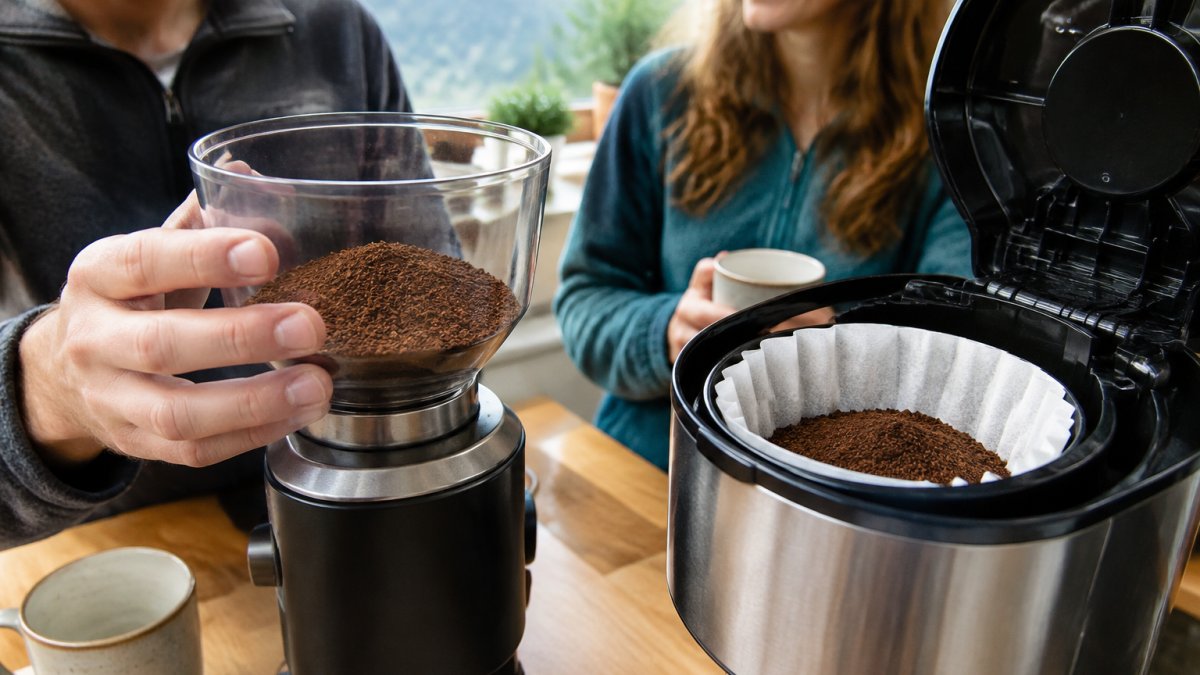
A quick way to test: brew one pot, then look at the spent grounds. If they look like mud, go coarser. If they look like they barely got wet, go finer. Our Precise28 Electric Burr Coffee Grinder holds a steady medium setting, which takes the guesswork out of repeatable pots.
The Coffee-to-Water Ratio for Drip Coffee That Stays Balanced
Start with a 1:16 coffee-to-water ratio by weight. That means 60 grams of ground coffee to about 1 liter (roughly 34 fluid ounces) of water for a full 12-cup pot, or 30 grams to 500 milliliters for a half pot.
Weigh your coffee if you can. A digital scale removes the biggest variable in home brewing, because a "scoop" varies wildly by grind and bean density. If you do not have a scale, one level tablespoon of medium-ground coffee weighs roughly 5 to 7 grams, so a 12-cup pot needs about 9 to 12 level tablespoons. Treat that as a starting point, not a rule.
Here is a repeatable drip recipe matched to medium-roast beans:
| Variable | Starting Point | Why It Matters |
|---|---|---|
| Dose | 60 g coffee per 1 L water (1:16) | Sets strength before any other adjustment |
| Grind | Medium, like coarse sand or table salt | Controls how fast water passes through the bed |
| Water temperature | 195-205°F | Extracts sweetness without scorching |
| Brew time | 4-6 minutes for a full drip cycle | Too fast under-extracts; too slow over-extracts |
| Water | Filtered, chlorine-free | Chlorine flattens flavor notes fast |
Brew one pot, taste it, then adjust one variable at a time. If the cup tastes weak or watery, add coffee before you change the grind, strength is a ratio problem first. If it tastes harsh or bitter, back off the dose slightly or go coarser. If it tastes sour or sharp, go finer or check that your brewer is reaching temperature.
Watch out: changing dose and grind at the same time makes it impossible to know which adjustment fixed the cup, so move one lever per pot.
A common pattern is that a full pot tastes better than a half pot in the same machine, because the water-to-coffee contact time changes with batch size. If you usually brew small batches, drop the dose proportionally and expect a slightly shorter cycle.
For a 12-cup pot, that means roughly 60 grams of coffee to about 1 liter of water. Three things move the ratio:
- Water temperature: aim for the 195-205°F range most brewers target.
- Brew time: a full drip cycle usually runs four to six minutes.
- Filtered water: chlorine flattens flavor notes fast, so filtered water is worth the small effort.
If your coffee tastes weak, add coffee before you add more grounds to the basket. If it tastes harsh, back off slightly.
Taste and Flavor Notes: What Medium Roast Brings to the Cup
Medium roast delivers a balanced flavor profile: moderate sweetness, gentle acidity, and a smooth body that carries chocolate and nutty notes without the char of a dark roast. It is the roast level most people picture when they think of a good everyday cup.
What you taste depends on origin and processing as much as roast. Our House Blend is a medium roast of Central and South American coffees with nutty, sweet chocolate and mild citrus notes.
Here is how the cup structure breaks down:
| Attribute | What Medium Roast Delivers |
|---|---|
| Body | Medium, rounded mouthfeel |
| Acidity | Gentle, not sharp |
| Sweetness | Caramel and chocolate tones |
| Bitterness | Low to moderate |
| Finish | Clean and bright |
Tasting method matters too. Let the cup cool a few minutes. Aromas open up as coffee drops below scalding, and you will pick up the sweetness and citrus notes you missed while it was hot. Slurp a little to spread it across your palate, then note what lingers.
Best Medium Roast Coffee With a Smooth Finish
For a smooth finish, look for a medium roast blend built for consistency. Our House Blend is a medium roast of Central and South American coffees with a medium body, nutty and sweet chocolate notes, and a bright finish. It is the cup we point people to when they want the same result every morning.

Smoothness comes from balance, not from weakness. A blend earns that quality when the roaster pairs beans that fill each other's gaps: one for body, one for sweetness, one for a lift of acidity. Single-origin coffees can be wonderful, but they vary more from lot to lot.
Our Breakfast Blend is the lighter, mellower option in the same medium range, built from South American coffees for an easy first cup.
Best for: daily drip drinkers who want a repeatable, smooth cup. Skip if: you prefer the smoky depth of a dark roast.
Best Medium Roast Arabica Coffee Beans and What to Look For
Arabica beans are the starting point for most specialty coffee, and medium roast Arabica coffee beans are where the variety's sweetness and acidity show best. Arabica carries more sugar and less caffeine than Robusta, which is why it tastes cleaner in the cup.
Four things to check before you buy:
- Roast date, not just a best-by date. Freshly roasted beans peak in flavor within a few weeks of the roast date.
- Whole bean over pre-ground. Ground coffee loses aroma quickly once the package is open.
- Origin detail. A named region tells you more than a vague "South America" label.
- Processing method. Washed beans taste clean; natural and pulped-natural beans taste sweeter and heavier.
Our Brazil Santos is a single-origin medium roast from Paraná and São Paulo, pulped natural and sun dried, with smooth cocoa notes. It is a clear example of what a well-sourced Arabica bean tastes like when roasted to medium and brewed as filter coffee.

Matching Beans to Your Drip Brewer and Fixing Weak or Bitter Cups
Match the grind to the brewer first, then adjust the ratio. Medium roast performs differently across the three common filter setups, and treating them as interchangeable is the fastest way to a disappointing cup.
Automatic drip machines are built for a standard medium grind. If your brewer has an aroma-control setting that steeps the grounds before releasing the coffee, a slightly finer medium grind works well because the pre-steep adds contact time.
Pour-over brewers reward a medium-fine grind and a slower, controlled pour. Medium roast shines here because the manual control lets you dial in extraction, but the same beans that taste balanced in a drip machine can taste thin if you pour too fast.
Batch brewers in larger formats need a coarser medium grind to keep the bed from choking. If the filter basket overflows or the cycle runs long, go coarser before you change the dose.
Weak coffee usually means too coarse a grind or too little coffee. Bitter coffee usually means too fine a grind, too hot a brew, or an overdue cleaning.
Run a vinegar cycle on your machine every month or two; old oils in the carafe and basket turn any bean bitter. Descale on the schedule your manufacturer recommends, and rinse the filter basket after every pot.
Our Kenmore 12 Cup Programmable Drip Coffee Maker has a charcoal water filter and an aroma-control setting that steeps the grounds before the coffee drops, which suits medium roast well. Set it the night before and the pot is ready when you are.

If bitterness persists after you fix the grind and clean the machine, work through our guide on how to troubleshoot bitter tasting coffee for the deeper causes.
Choose Your Beans and Start Brewing
You now have the full picture: medium grind, a 1:16 ratio, filtered water, and a fresh medium roast bean. That combination produces a balanced, smooth cup from almost any drip machine.
The variable worth upgrading first is freshness. Buy whole bean, store it in an airtight container away from light and heat, and buy in quantities you will finish within a few weeks rather than months. A bag that sits open on the counter loses its best notes long before it goes stale.
At Ridgeline Trail & Coffee, we roast medium for exactly this kind of daily brewing. Search our coffee collection to find the House Blend, Breakfast Blend, or Brazil Santos, and pair your beans with a grinder that holds a steady medium setting. Get started with Ridgeline Trail & Coffee and brew a better pot tomorrow morning.
Frequently Asked Questions
Which roast is best for drip coffee?
Medium roast is the safest match for most drip brewers. It keeps enough acidity and sweetness to stay interesting while extracting evenly at the temperatures and brew times a standard automatic drip machine runs. Dark roasts can turn bitter on a warming plate, and light roasts often taste thin when a drip brewer finishes too fast. If you want one bag that works every morning without adjusting anything, start with a medium roast.
What grind size works best for medium roast coffee in a drip brewer?
Use a medium grind, close to the texture of coarse sand. It looks like table salt but slightly rougher. Too fine and the water stalls, pulling out bitterness; too coarse and the water runs straight through, leaving a sour, weak cup. If your brewer has a flat-bottom basket, stay on the medium side. If it uses a cone filter, a touch finer is fine. Grind fresh right before brewing for the clearest flavor.
How much coffee should you use for drip coffee?
Start with a coffee-to-water ratio near 1:16 by weight, then adjust: weaker than you like means add coffee, harsh or drying means back off slightly or coarsen the grind.
How can you make medium roast drip coffee taste smoother?
Three levers do most of the work. Keep the grind medium and consistent so extraction stays even. A medium roast with nutty, chocolate and mild citrus notes, like our House Blend from Central and South America, brews a smooth cup when you keep the method simple.