 how-to
Streamline Your Morning Coffee Routine: 7 Steps
Table of Contents
- Why Your Morning Coffee Routine Matters
- Best Coffee for Busy Mornings: Choosing the Right Beans
- Pre-Measuring Coffee Beans the Night Before
- Coffee Station Organization Ideas for Speed
- Selecting the Right Grind Size and Brewing Method
- Water Quality and Temperature: The Efficiency Factor
- Automating Your Routine: Equipment That Saves Time
- Frequently Asked Questions
Last Updated: September 29, 2026
Why Your Morning Coffee Routine Matters
A strong morning coffee routine sets the tone for your entire day. It's not just about caffeine, it's about building a ritual that energizes you before the rush begins.
Most people rush through their coffee, grabbing random beans and amounts. The result: inconsistent flavor and wasted time.
A simplified morning coffee routine eliminates this chaos by planning ahead and organizing your setup the night before.
When you remove friction from your routine, coffee becomes a moment of clarity instead of a chore.
Best Coffee for Busy Mornings: Choosing the Right Beans
The type of coffee beans you choose directly impacts your morning speed and flavor satisfaction. For busy mornings, you need beans that are fresh, consistent, and suited to your brewing method.
Look for beans labeled as specialty-grade coffee. These have higher quality standards and deliver better flavor with less effort. Medium roasts work well for most brewing methods and tend to be more forgiving than light or dark roasts.
Match beans to your brewing method: French press needs fuller-bodied beans, espresso demands finer concentrated flavors, and drip coffee works with a wider range.
Buy whole beans rather than pre-ground; they stay fresher longer and deliver better aroma and flavor.
Store beans in an airtight container in a cool, dark cupboard to extend freshness and ensure consistent flavor.
Pre-Measuring Coffee Beans the Night Before
Pre-measuring your coffee beans the night before eliminates guesswork about how much coffee to use.
Use a digital scale to measure beans by weight. A standard ratio is 1 gram of coffee per 16 milliliters of water; consistency matters more than the exact ratio.
Weigh out your beans into small containers or jars the evening before. Label each container with the date and brewing method. This removes all guesswork from your morning.
A scale like the PRECISE28 Electric Burr Coffee Grinder lets you measure with precision. You can set it to grind the exact amount you need for 2 to 12 cups, then walk away, it stops automatically when done.

If you brew the same amount daily, reuse the same container, a visual cue that eliminates mental math.
Store pre-measured beans in airtight containers and grind fresh each morning for maximum aroma and flavor.
Coffee Station Organization Ideas for Speed
A well-organized coffee station cuts prep time in half by arranging everything within arm's reach in workflow order.
Designate a specific counter as your coffee zone with grinder, scale, brewing equipment, and water source in one location.
Arrange equipment in workflow order: grinder, scale, brewing device, cups. Your hands flow naturally from one tool to the next.
Store pre-measured beans at eye level in clear, airtight containers. Label each container with the bean type and date. You'll see at a glance what you have and when it was measured.
Keep your brewing method visible and ready, removing the step of retrieving equipment saves 2-3 minutes.
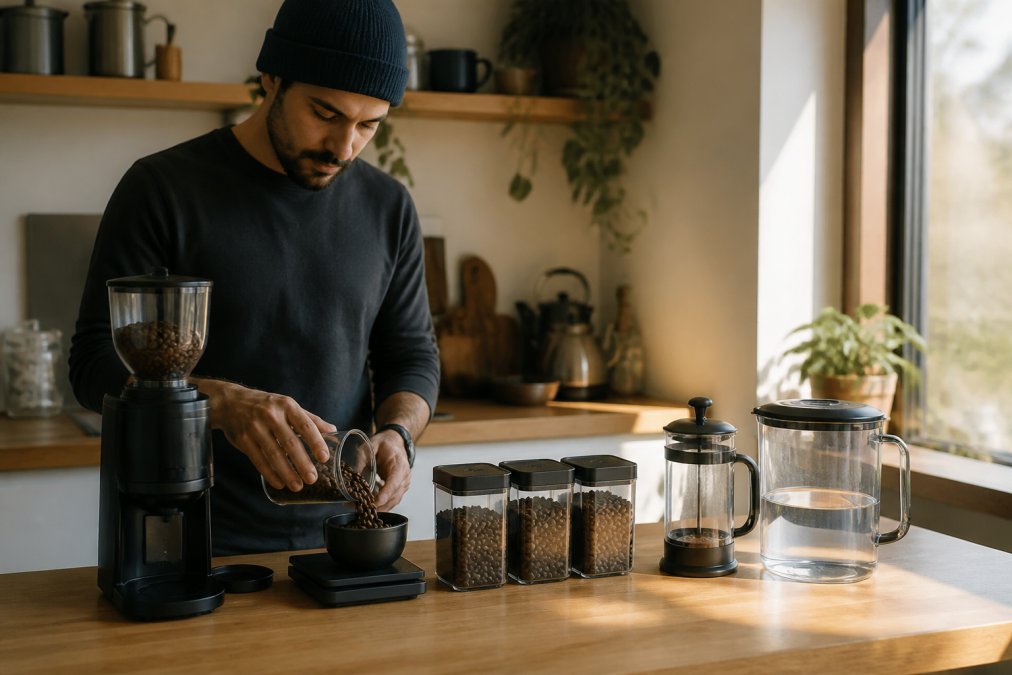
Place your water source at the end of your workflow as your final step before brewing.
Use drawer dividers or small bins to corral coffee accessories: spoons, filters, cleaning brushes. Everything has a home. Nothing gets lost or forgotten.
Selecting the Right Grind Size and Brewing Method
Grind size determines extraction speed and must match your brewing method.
French press requires a coarse grind (like breadcrumbs) to avoid over-extraction during steeping.
Drip coffee makers work best with medium grinds (like sand) to balance extraction and flavor.
Espresso demands a fine grind (powdery) to maximize extraction under pressure.
A burr grinder gives you precise control over grind size. The Compact Home Coffee Bean Grinder offers adjustable settings for espresso, drip, and French press, with one-touch operation and quiet performance. You set it once and grind fresh every morning.

Avoid blade grinders; they produce inconsistent particle sizes and heat that damages flavor.
Match brewing method to your lifestyle: pour-over or AeroPress for five minutes, French press for ten minutes.
The AeroPress Original Portable Coffee Maker brews smooth, grit-free coffee in about a minute using micro-filtration. It's durable and shatterproof, making it reliable for any morning routine.

Water Quality and Temperature: The Efficiency Factor
Water quality and temperature have the largest impact on flavor consistency and brewing speed. Inconsistent water forces daily adjustments to grind size, brew time, or coffee amount.
Filtration and Mineral Content
Tap water contains chlorine and minerals that interfere with extraction and cause buildup in equipment.
A simple pitcher filter removes chlorine and reduces mineral content. Use filtered water exclusively if your tap water is visibly cloudy or has a strong odor.
Filtered water eliminates one variable, so your 1:16 ratio works consistently and you stop troubleshooting.
PRECISE28 Electric Burr Coffee Grinder →
Temperature Control and Extraction Speed
Water temperature controls extraction speed. The Specialty Coffee Association recommends 195-205°F for most brewing methods.
Below 190°F causes under-extraction (sour, weak coffee). Above 205°F causes over-extraction (bitter, astringent). At 195-205°F, flavor develops fully in the shortest time with predictable results.
French press (4 minutes) needs 200°F, pour-over (2-3 minutes) needs 202°F, and espresso (25-30 seconds) needs 200-202°F for consistent extraction.
Practical Temperature Workflow
A temperature-controlled kettle removes guesswork and saves 2-3 minutes by heating to target temperature once, then brewing immediately.
With a standard kettle, let boiling water cool 30 seconds before pouring, no extra time if you're grinding during that window.
Maintenance to Prevent Disruption
Hard water leaves mineral deposits that slow heating, clog burrs, and cause equipment failure.
If your tap water is hard, descale your kettle and grinder every 2-4 weeks using food-grade descaling solution. For kettles: fill, heat, sit 15 minutes, rinse. For grinders: run solution through, then clean water until clear.
Alternatively, use filtered water exclusively to eliminate mineral buildup entirely. The cost of a pitcher filter ($5-8 per month) is far less than replacing a grinder or kettle.
The real efficiency comes from consistency. When your water quality and temperature are the same every morning, your brew time is predictable, your flavor is stable, and you stop troubleshooting. This is where the 3-minute morning coffee routine becomes possible.
Automating Your Routine: Equipment That Saves Time
Automation only saves time if it removes a step that currently slows you down. Adding gadgets for their own sake creates complexity and increases the chance of equipment failure disrupting your entire routine. The key is automating the right bottleneck.
Identifying Your Bottleneck
Before buying any automated equipment, time your current routine for three mornings. Measure how long each step takes: measuring beans, grinding, heating water, brewing, pouring, cleaning. The step that takes the longest or requires the most active attention is your bottleneck.
For most people, the bottleneck is one of these three:
- Grinding: Manual or slow grinders take 2-4 minutes. An electric burr grinder cuts this to 30-60 seconds.
- Heating water: Waiting for water to boil takes 3-5 minutes. A temperature-controlled kettle heats and holds temperature, cutting wait time to 1-2 minutes.
- Brewing: Certain methods (French press, pour-over) require active attention for 4-5 minutes. A programmable drip maker brews while you dress, saving active time.
Automate only the bottleneck. Automating a 30-second step wastes money and adds a device to maintain.
Electric Burr Grinders with Preset Buttons
An electric burr grinder with preset buttons eliminates measuring and guessing. You select your cup count (2, 4, 6, 8, 10, or 12 cups), press start, and it grinds the exact amount needed, then stops automatically. This removes the decision-making step and the risk of over-grinding.
The time savings: 2-3 minutes per morning, plus consistency. The same button press produces the same grind amount every time, so your brew time and flavor are predictable.
Maintenance requirement: Clean the burr chamber every 1-2 weeks by running a grinder-cleaning tablet (like Cafiza) through it, then grinding a small amount of rice to absorb oils. This 5-minute task prevents rancid flavor and burr jamming. If you skip this, the grinder slows and eventually fails, forcing you back to manual grinding or buying a replacement.
Temperature-Controlled Kettles
A kettle with a digital display and hold function heats water to your target temperature (195-205°F) and keeps it there for 30 minutes. You press a button, wait 2-3 minutes for the water to reach temperature, then brew immediately. No guessing, no thermometer, no waiting for cooling.
Time savings: 1-2 minutes per morning, plus consistency.
Programmable Drip Coffee Makers
Smart Home Integration (Conditional)
The Maintenance Checklist
Weekly:
- Empty and rinse the drip coffee maker's filter basket and carafe.
- Wipe the grinder's exterior and burr chamber with a dry cloth.
Every 2 weeks:
- Run a grinder-cleaning tablet through your electric grinder, then grind a small amount of rice to absorb oils.
- Inspect your kettle's heating element for visible mineral buildup.
Every 1-2 months:
- Descale your kettle with a food-grade descaling solution (citric acid or commercial descaler). Fill, heat, let sit 15 minutes, rinse thoroughly.
- Descale your drip coffee maker by running a descaling solution through a brew cycle, then running clean water through 2-3 cycles.
- Deep-clean your grinder's burr chamber by disassembling (if possible) and wiping burrs with a dry cloth.
The Real Time Savings
Frequently Asked Questions
How can I make my morning coffee routine faster without sacrificing quality?
Pre-measure beans the night before, organize your coffee station in workflow order, and use a burr grinder set to your preferred grind size. These three steps cut prep time by 5-10 minutes while keeping extraction and flavor consistent. A digital scale ensures precise ratios every time, eliminating guesswork and failed brews.
What is the best coffee for busy mornings?
Choose single-origin beans with a medium roast and consistent freshness. Single-serve options like instant coffee work well for extreme time constraints, 30 servings in a resealable pouch require only hot water. For quality-focused routines, whole beans stored in airtight containers and ground fresh deliver the best sensory experience and aroma in minimal time.
How does pre-measuring coffee beans affect freshness?
Grinding fresh beans just before brewing preserves aroma and flavor profile best. If you pre-measure whole beans the night before, store them in an airtight container away from light and heat. This keeps them fresh for 12-24 hours. Grinding ahead of time accelerates oxidation, so measure whole beans only and grind each morning for optimal freshness.
What brewing method is fastest for a busy morning?
The AeroPress Original brews smooth, full-bodied coffee in about one minute with no grit and minimal cleanup. For even faster service, instant coffee requires only hot water. French press takes 4-5 minutes but demands less equipment. Match your method to available time: instant for extreme rush, AeroPress for quality speed, French press for ritual when you have 10 minutes.